Language awareness / Talking point
Sonido
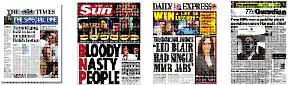
In the United Kingdom there are two types of newspapers; broadsheets and tabloids.
Broadsheets - Serious newspapers focusing on current political affairs and events.
Tabloids - Newspapers focussing on less "serious" content, especially celebrities, the Royal Family, sports, and sensationalist crime stories.
A. Look at the following examples of the same story and decide which is written in a broadsheet style and which is written in a tabloid style
(Para ver las soluciones haga doble click en el área sombreada; un click vuelve a posición original)
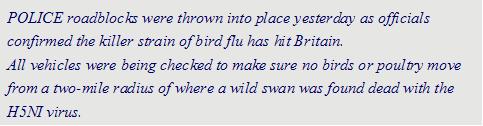
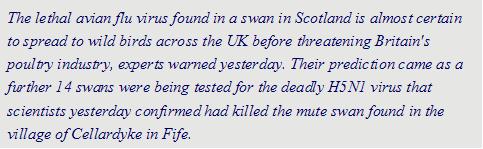
Headlines
Headline writing is considered a very skilled job. A good headline must:
- Fit the story and tell the reader clearly what it's about.
- Make the reader interested in the story and want to read on.
B. Look at the following headlines and match the word underlined in the headline to the explanation given in the list.
drop / marries / starts / prohibits / found not guilty / danger / exposes / tries / stopped / insists on / disappeared / close / progresses / delay / mocks
| 1) | Labour launch local election campaign | |
| 2) | Teenage brothers cleared of murder | |
| 3) | Amnesty demands public inquiry | |
| 4) | MP weds actress | |
| 5) | Gambling website seeks to enlarge its empire | |
| 6) | International laws hinder uk troops | |
| 7) | Study reveals financial crisis | |
| 8) | Brown axed benefit to damage local elections | |
| 9) | Artesanal evolve thaks to wenger | |
| 10) | George bush´s slide inpopularity | |
| 11) | Riot police seal off paris streets | |
| 12) | EU bans almost 100 airlines from its skies | |
| 13) | John taunts the torries | |
| 14) | The baby who vanished | |
| 15) | Peril on oil rig | |
Corregir
Ver Solución
Limpiar | ||
Headline Techniques
As seen above, headlines use special vocabulary and also particular grammatical forms. Here is a list of some of the forms of language and techniques used by headline writers.
- Alliteration - repeating the same first letter or syllable in successive words to create a poetic or humorous effect (Sweet Smell of Success).
- Cliché - An over-used phrase or expression which has lost its originality e.g. the sun always shines after the rain.
- Euphemism - the use of a polite or pleasant form of words to describe something less pleasant e.g. the little boy's room.
- Exclamation - usually used to indicate surprise, sarcasm or amusement e.g. Woow!
- Metaphor - comparison between two unconnected people or things e.g. the housing bubble has burst.
- Metonym - where the name of a specific object or idea stands for something else to which it is related or a part of, e.g. the Royal Family is often referred to as The Throne of The Crown.
- Pun - a play on words, often with a double meaning e.g. What kind of a tree grows on your hand? A palm tree.
- Rhyming - words ending in identical sounds e.g. fat mat sat on his cat.
- Slang - words or phrases not considered part of standard English e.g. cool, dago, da bomb
C. Try and match one of the techniques with one of the following headlines
| 1) | The were-rabbit of northumberland | |
| 2) | Posh and becks fly home | |
| 3) | There´s no place like home | |
| 4) | Sophistiscated Mariah smells so sweet | |
| 5) | Riot cops sent to nick two children | |
| 6) | Global climate change investigated | |
| 7) | What a beutiful day! | |
| 8) | Van man banned | |
Corregir
Ver Solución
Limpiar | ||
Talking Point
Would you like to be a celebrity? If yes, why? How do you imagine the life of a celebrity? What are the advantages of being a celebrity? And what are the disadvantages? What are the dangers of becoming a celebrity/millionaire overnight?