Isabel’s Hobbies
1.- Vocabulary – Adverbs
Adverbs of Manner
Slowly: lentamente
Quickly: rápidamente
Suddenly: de repente
Gradually: gradualmente
Badly: malamente
Calmly: tranquilamente
Easily: fácilmente
Seriously: en serio
Regularly: regularmente
Happily: felizmente
Eventually: finalmente
Carefully: cuidadosamente
Immediately: inmediatamente
Honestly: honradamente
Quietly: silenciosamente
Ambitiously: ambiciosamente
Adverbs of Place
Here: aquí
There: allí
Behind: detrás
Above: encima de
Adverbs of Time
Now: ahora
Then: entonces
Yesterday: ayer
Adverbs of Frequency
Never: nunca
Sometimes: a veces
Often: a menudo
Usually: normalmente
Always: siempre
Hobby
Free time: tiempo libre
2.- Grammar – Adverbs
Adverbs are used to describe a verb, an adjective, or another adverb:
- Tom sings beautifully Verb
- David is extremely clever Adjective
- This car goes incredibly fast Adverb
Form:
Many adverbs are formed by adding –ly to an adjective
Example:
Adjective | Adverb |
bad | badly |
quick | quickly |
soft | softly |
easy | easily |
honest | honestly |
However, if the adjective ends in y, change y - i and add -ly.
Adjective | Adverb |
Heavy | Heavily |
Happy | Happily |
Lazy | Lazily |
Not all adverbs end in –ly. There are some exceptions
Adjective | Adverb |
good | well |
late | late |
early | early |
fast | fast |
hard | hard |
2.A.- Practice
A – Put the following adjectives into adverbs.
1) Calm 2) Complete 3) Excellent 4) First 5) Patient
3.- Grammar – Position of adverbs
In this lesson we are going to look at the position of 4 different types of adverbs:
- Adverbs of Manner
- Adverbs of Place
- Adverbs of Time
- Adverbs of Frequency
Adverbs of Manner
- Quickly, slowly, carefully, softly, etc.
These adverbs are put after the direct object (or after the verb if there's no direct object):
Subject + Verb + Direct Object + Adverb
Examples:
- I eat the apple quickly
- I eat quickly
Adverbs of Place
- Here, there, behind, etc
These adverbs are put after the direct object or the verb (or after the verb if there’s no direct object).
Subject + Verb + Direct Object + Adverb
Examples:
- He saw the dog there
- He stayed there
Adverbs of Time
- Now, yesterday, tomorrow, etc.
Adverbs of time are usually put at the end of the sentence or at the beginning of the sentence.
Time + Subject + Verb Direct + Object Time
Examples:
- I went to hospital yesterday
- Yesterday I went to hospital
Adverbs of Frequency
- Sometimes, often, never, etc.
Adverbs of frequency are put before the main verb. If 'be' is the main verb and there is no auxiliary verb, adverbs of frequency are put after 'be'.
Subject + Auxiliary / be + Adverb + Main Verb + Object, Place or Time
Examples:
- They sometimes go to the park on Saturdays
- He doesn’t often play football
- She is never at home
- I have always been to Spain
3.A.- Rewrite the sentences including the adverb.
1) He speaks (slow) 2) The girls laughed (happy) 3) She hurt her leg (bad) 4) Let´s go (out) 5) The children are playing (out)
3.B.- Put the words in the correct order to make a sentence
1) always Spain to go we summer in 2) patiently she waited 3) don´t in summer we skiing go 4) in London were last month go 5) ferry we by go sometimes 6) never him I before have seen
3.C.- Write the correct form of the word in brackets (adjective or adverb)
1) Tara . She´s an actress (excellent) 2) They learn English . They think English is an languaje (easy). 3) Alex is a singer. He sings (good). 4) Claire is always very . She climbed the mountain (careful)
4.- Reading
(Para ver la traducción hacer doble click en el texto; un click vuelve a posición original)
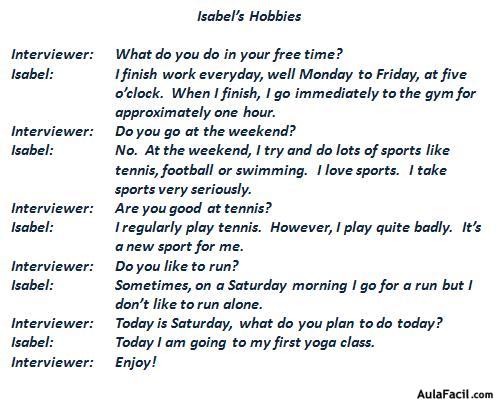
4.A.- Practice
4.A.1.- True or False.
| 1) | Isabel works on Sundays. | |
| 2) | Isabel goes to the gym everyday. | |
| 3) | Isabel loves to play sports. | |
| 4) | Isabel is good at all sports. | |
| 5) | Isabel likes to run with other people. | |
| 6) | Today, Isable is going to play football. | |
Corregir
Ver Solución
Limpiar | ||
4.A.2.- List 4 adverbs mentioned in the text
| 1) | ||
| 2) | ||
| 3) | ||
| 4) | ||
| 5) | ||
| 6) | ||
| 7) | ||
Corregir
Ver Solución
Limpiar | ||