Listening - Recycling
| Sonido |
You will hear a member of "Go Green!" explaining why we should recycle. Answer the following questions. You may listen twice to the recording.
What happens to OUR rubbish?
Once the dustmen have taken our rubbish away, most of it gets dumped in huge landfill sites. Most sites eventually get covered with soil, but they cannot be used to grow crops, and they are not strong enough for buildings. Then, all the rubbish inside them begins to decompose and many poisonous gases and liquids seep out into the soil.
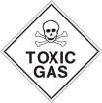
Some seep into the water supply. Fires on landfill sites are also common because chemical reactions take place below the surface. Other rubbish is burned in incinerators - but sometimes that releases toxic fumes and leaves poisonous ash behind.
Why recycle?
Recycling material to make new products costs less and requires less energy than using new materials. Recycling also reduces pollution, either by reducing the demand for high-pollution alternatives or by minimizing the amount of pollution produced during the manufacturing process. Recycling also decreases the amount of land needed for trash dumps by reducing the volume of discarded waste.
What can we recycle?
Just about any material can be recycled. On an industrial scale, the most commonly recycled materials are those that are used in large quantities:
Metals such as steel and aluminium, plastics, paper, glass, and certain chemicals.
For example:
- Paper - Paper is made from trees. Making new paper harms the environment as the process usually involves chlorine bleach, which pollutes rivers. It is a lot better to use unbleached, recycled paper. Not only can newspapers be recycled, but also magazines, cardboard, paper bags and envelopes.
- Glass - All main towns now have bottle banks. If glass is not reused, it lasts forever, broken and buried in the soil.
- Clothes - Take all old clothes to a charity shop like Help the Aged or Oxfam. Some will be sold; others will go to the main Waste saver Unit and will be sorted according to material and returned to textile mills for recycling. And much much more!
Action
Here are a few ways in which YOU can make a difference:
- Sort out your rubbish. Good recycling only begins when things are separated from each other.
- Find out where your nearest bottle, paper and clothes banks are. Use them.
- Avoid plastic wherever you can. It is very difficult to recycle.
- Use recycled paper.
Questions
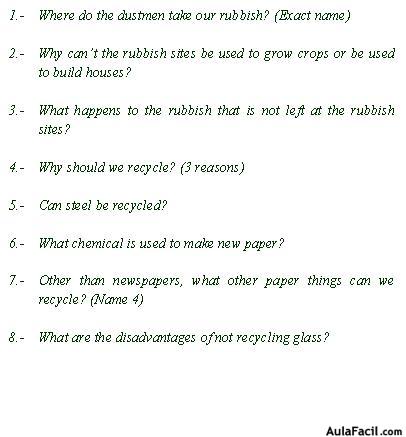
Answer the following questions.
(Haga doble click sobre las preguntas para ver las respuestas; un click vuelve a posición original)
True or False
| 1) | You must always separate before you recycle | |
| 2) | Plastic can be recycle | |
Corregir
Ver Solución
Limpiar | ||