Reading - G8´s free trade project is here to stay - along
Sonido
G8's free trade project is here to stay - along with world poverty
Caroline Lucas and Vandana Shiva
Monday July 4, 2005, The Guardian
As world leaders prepare to meet in Gleneagles, against the backdrop of activist protests and the Make Poverty History carnival in full swing, their pursuit of ever-freer international trade is in the dock as never before.
Anti-poverty and development campaigners are united in their support for the Make Poverty History campaign, which demands an increase in aid, debt cancellation and, crucially, reform of the rules governing international trade.
At the same time, the EU - the world's second largest trading bloc - is in political crisis, thanks to voters' rejection of the EU constitution in France and the Netherlands, driven partly by concerns over the EU's enthusiasm for economic globalisation.

In rejecting the constitution, France and the Netherlands in effect joined the list of countries, both rich and poor, that are calling ever-more loudly for protection against the impact of cheap imports. This is fuelled, at least in part, by the penetration of the world's textile markets by China, after protective quotas were abandoned earlier this year.
According to the European Apparel and Textile Organisation (Euratex), the EU's textile sector risks losing 1,000 jobs a day, and up to 1,000,000 jobs before the end of next year, prompting it to call for the introduction of quantitative restrictions.
In response the EU trade commissioner, Peter Mandelson, agreed a stop gap deal with China in May to slow down its rate of take over of the EU market to about 10% a year for three years.
Severe as these impacts are for Europe, for many developing countries they will be devastating. Since the 1980s, largely as a result of the quota system in place until this year, many have built a huge dependency on the textile sector. In 2000, it accounted for 95% of all Bangladesh's industrial goods exports, in Laos 93%, Cambodia 83%, Pakistan 73%, Sri Lanka 71%, and Nepal 61%. The sector employs more than 1.8 million workers in Bangladesh, 1.4 million in Pakistan and 250,000 in Sri Lanka. Little wonder, then, that at the end of last year several dozen developing countries made an 11th-hour appeal to the WTO to save their textile industries from Chinese imports - it fell on deaf ears.
The accession of China to the WTO in 2001 is likely to be seen as a turning point in the battle against free trade as livelihoods are lost all over the globe. Eventually rich and poor nations will be forced to ask themselves: is there any sector in which China does not have a comparative advantage based on cheap labour and ever increasing technical expertise?
The other Asian power, India, is - like Europe - facing a political backlash against economic globalisation. Last year India's farmers, who make up 70% of the population, voted to throw out the BJP government and its championing of "shining India". This emphasised an urban, hi-tech, open market future. But India was not shining for the majority of her farmers and for the last few years Indian activists and those campaigning for real trade justice have been calling for increased self reliance and trade rules that benefit the poor.
These negative experiences of free trade have informed Make Poverty History's demand for a trading system that allows poor countries to protect themselves from damaging imports.
However at Gleneagles it is apparent that there is a glaring contradiction between this demand and the G8's interpretation of "trade justice". The latter is a free market travesty of such a programme. The UK chair is a cheerleader for it and, needless to say, a critical questioning of the G8's fundamental commitment to economic globalisation has never been on the table.
As a result, the summit will remain primarily a vehicle for pushing ahead with the free trade project shared by these, the world's most powerful men. The G8 countries will doubtless drop a few more crumbs of aid to their poorer neighbours, and may even keep their pledges to cancel some of the debt with which so many developing nations are shackled. However the effects of this apparent largesse will be swallowed up many times over by the negative impact on poor countries of being forced to open their markets to international competition.
Whatever gloss the post-summit statement puts on it, the result of all this free trade emphasis is, in fact, to make poverty inevitable.
Yet as trade specialists from the north and south we know that regardless of the results of the G8, the threat to livelihoods worldwide from freer trade will continue apace, as will the political reaction against it. This will centre on an increasing clamour for protective barriers, both north and south. This demand could be a crucial step towards really making poverty history while allaying the fears of the no voters in Europe worried about the threat to jobs of cheap imports and relocation.
The present open market emphasis of the G8, WTO and the EU urgently needs to be replaced by trade rules that encourage the protection and diversification of domestic economies.
They should also allow exporting governments to set the terms of the trade so that they benefit the majority of their people, rather than the interests of big business at present encoded in the WTO's "free and unfair" trade rules.
This approach would allow the G8 to offer its peoples a more secure economic future but one that interacts with the rest of the world in a way beneficial to the poor everywhere, thus meeting the desires of all of us worldwide who are seeking to Make Poverty History.
(Haga doble click sobre las preguntas para ver las respuestas; un click vuelve a posición original)
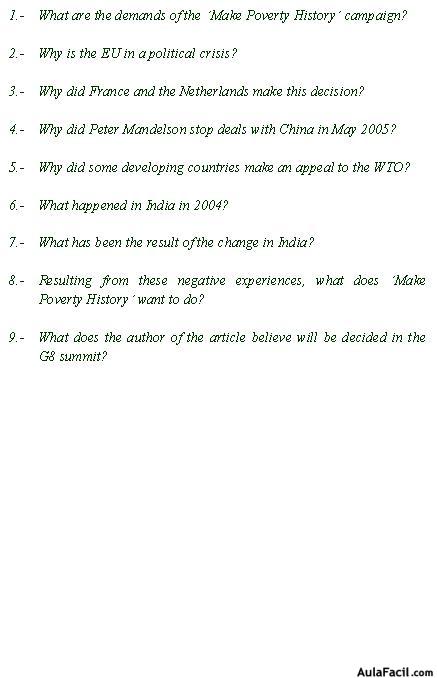
Read the text through carefully and answer the following questions in your own words.
True or False
| 1) | Make Poverty Histroty and the G8 have the same interpretation of Trade Justice | |
| 2) | The most influential countries will attend the summit | |
| 3) | The G8 countries will probably cancel all of the debt oweb by underdeveloped countries | |
Corregir
Ver Solución
Limpiar | ||
Questions
| 1) | What would the Make Poverty History organization like to see happen in the future? | |
Corregir
Ver Solución
Limpiar | ||
Questions
| 1) | What does this expression mean: 'drop a few more crumbs of aid to their poorer neighbours'? | |
Corregir
Ver Solución
Limpiar | ||