
Grammar
Grammar - Verb + Infinitive
A. The to-infinitive is used:
1. To express purpose
- I went to the shop to buy some fruit.
- They never wanted to go away on holiday.
2. after certain verbs
agree / choose / dare / decide / expect / forget / help / hope / learn / manage / need / offer / promise / refuse / seem / want / would like / would love / would prefer / would hate
- The teacher agreed to help the student with her homework
- I promised to wash Pete's car before Sunday
3. After certain adjectives e.g. disappointed, relieved
- We were disappointed to find out that our cat had been run over
4. As grammatical subject
- To get to Cuffley you need to take Junction 17 of the M25.
5. After too/enough
- This is not enough food here to eat
B. Bare Infinitive
The bare infinitive is used:
1. After certain modal verbs
- I can speak French and Italian
- We must go to the park
2. Verb + somebody + infinitive (no to)
- I made her give me back my book
3. After certain expressions: would rather/sooner, had better, why not..
- I'd rather watch that film
- We'd better arrive on time
Exercises
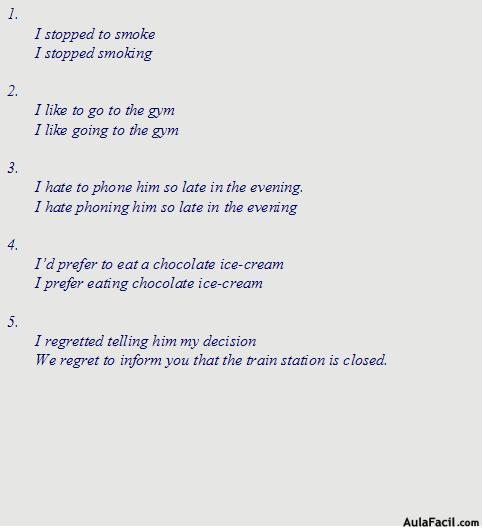
A. Comment on the differences in meaning between the following pairs of sentences
(Para ver las soluciones haga doble click en el cuadro; un click vuelve a posición original)
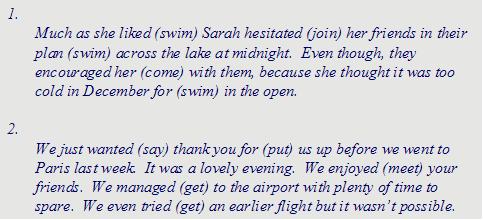
B. Complete the following paragraph by putting the verb in brackets into the correct form: gerund, bare infinitive or to-infinitive.
C. Finish each of the following sentences so that it means the same as the sentence above it. In each case, use a gerund, bare infinitive or to-infinitive.
| 1) | It was good of you to go to the meeting. I really appreciated it. I really appreciated | |
| 2) | You seem to do nothing but complain. I´ve had enough of it. I´m fed up | |
| 3) | She hid her nervousness from us. She didn´t let us | |
Corregir
Ver Solución
Limpiar | ||